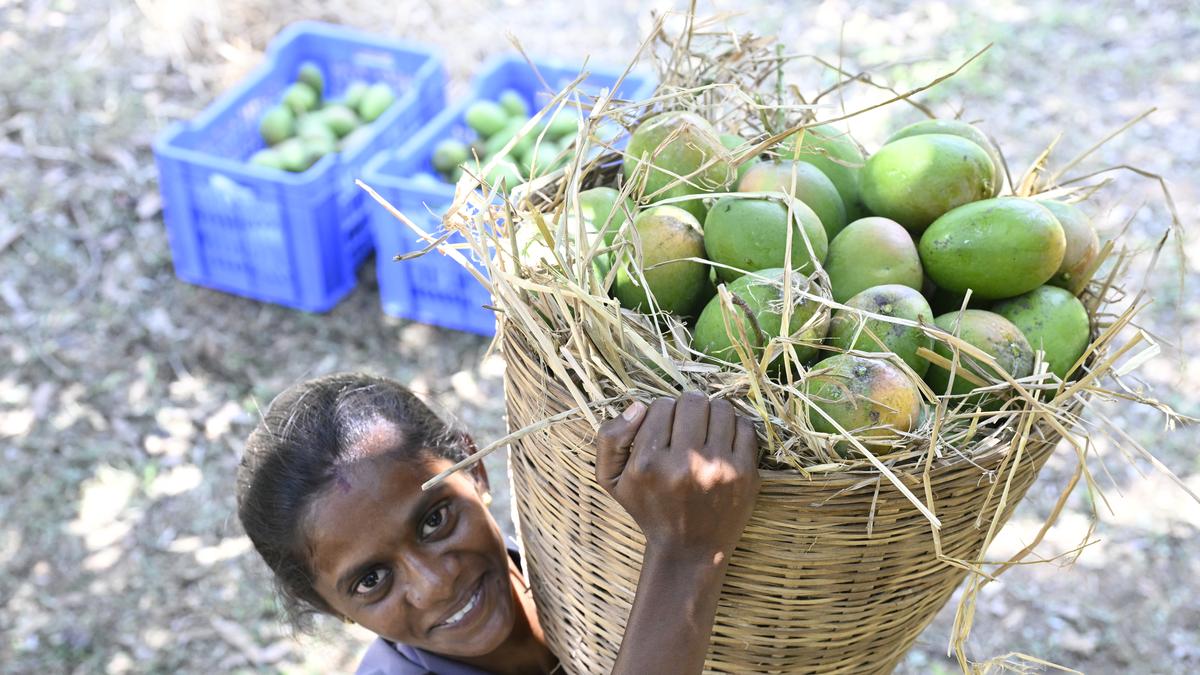
Mangoes 2025: Tamil Nadu farmers on the season’s specialities
July 17, 2025e-Paper
The View From India Looking at World Affairs from the Indian perspective.
First Day First Show News and reviews from the world of cinema and streaming.
Today's Cache Your download of the top 5 technology stories of the day.
Science For All The weekly newsletter from science writers takes the jargon out of science and puts the fun in!
Data Point Decoding the headlines with facts, figures, and numbers
Health Matters Ramya Kannan writes to you on getting to good health, and staying there
The Hindu On Books Books of the week, reviews, excerpts, new titles and features.
July 17, 2025e-Paper
Mangoes 2025: Tamil Nadu farmers on the season’s specialities
Premium
Now that peak mango season has arrived, farmers across Tamil Nadu give us a lowdown on varieties to look out for, sharing stories of survival against the odds
Updated - May 18, 2025 09:56 am IST
Organic Alphonso mangoes being harvested at K Baskar’s 40-acre farm in Andipatti in Tiruppur district. | Photo Credit: PERIASAMY M
A squirrel has scooped out a tiny hole in an Imam Pasand mango that farmer K Baskar has set aside. “I had left the box outside just a few minutes ago!” he chuckles. Animals and birds make away with a lot of the produce at his 40-acre organic farm that borders Dindigul district. But he works his way around this, given that his farm at Andipatti in Tiruppur district also abuts the Anamalai Tiger Reserve. Baskar grows Alphonso, Imam Pasand, Neelam, and Malgova varieties on his 800 mango trees.
Now that peak mango season has arrived, farm hands are busy plucking mangoes that will be shipped across Tamil Nadu. | Photo Credit: PERIASAMY M
Farm hands are harvesting the fruits from this orchard one summer afternoon using a long pole bearing a scissors-like contraption that snips the mango from the branch. It falls into a small net right beneath, and the fruit is transferred to a waiting basket below. Every mango is dealt with care — after all, Baskar waited a year for this moment.
Farm hands use a long pole bearing a scissors-like contraption that snips the mango from the branch. It falls into a small net right beneath, and the fruit is transferred to a waiting basket below. | Photo Credit: PERIASAMY M
Also read | The Mangoes of India
“This year, I’m seeing only 30% of yield,” says the 48-year-old, adding that he lost over 500 kilograms of mangoes a few days ago due to an unexpected gust of heavy winds. But he is keeping his chin up, packing off mangoes to customers across India. “Mangoes are extremely sensitive to rains,” he says, as we make our way through prickly undergrowth towards a tree laden with Alphonso mangoes. “If there is too much rain, the fruit might not hold much sugar content.” The Alphonsos are a mix of dark and light green, with a few showing smudges of orange. The smell — a heady combination of earth and rain with sweetish undertones — is an indicator that the fruits are ready to be harvested.
Climate change and unseasonal rains have affected produce | Photo Credit: PERIASAMY M
According to the Tamil Nadu Agricultural University’s Agritech Portal, India ranks first in the world among mango producing countries. In Tamil Nadu, major mango growing districts are Dindigul, Theni, Dharmapuri, Krishnagiri, Vellore, and Thiruvallur. Salem, known for its Gundu variety, is yet another mango hub. Farmers report that the season has been in its peak over the past 15 days in the region.
Mango farmer K Baskar, who is based in Coimbatore, at his 40-acre organic farm in Andipatti in Tiruppur district | Photo Credit: PERIASAMY M
According to Sathish Ramasamy, who owns 35 acres in Magudanchavadi, Salem, they initially faced issues with quality. Right now though, their fruits are in great form. Sathish, who runs the company Salemmango, sells online and has customers across India. “I do not use chemicals since our farm is located in a rain-fed area,” he says, adding that mango farmers from near and far visit his farm to understand how it is possible to grow mangoes organically.
Freshly-harvested mangoes | Photo Credit: PERIASAMY M
Friends and software professionals Shyam Sembagoundar and Siva Sankar, who hail from Salem and work in the US, help Salem mango farmers find customers through their online venture Namkalam. “We route customers directly to farmers,” explains Shyam. He adds that farmers who they work with drop off produce at the Salem market. The two of them then package the fruits to ship to people across Tamil Nadu, and offer a holistic approach to customer service complete with a refund if there are issues. The idea, Shyam explains, is to help farmers sell their produce for a good price.
While mango trees are known to be hardy, climate change is making things difficult for farmers by springing up unseasonal rains. Those following organic methods find it even more challenging. But they are dealing with the problem with techniques such as biological sprays.
Ajay Kuruvila, a farmer based in Dindigul, curates mangoes from organic farmers from the district, supplying to organic stores in Chennai, Coimbatore, and Madurai. Ajay explains that once the mangoes are harvested with their stalks intact, they are set upside down to let the sap flow, washed in alum, and then packed. “This is so that the fruit does not develop black blemishes once it ripens,” he says.
The Vazhaipoo variety of mangoes at KS Jaganatha Raja’s farm in Rajapalayam | Photo Credit: ASHOK R
Apart from Sappattai, Malgova, and Imam Pasand, farmers in the region are also harvesting Karunkurangu, a large, sweet variety, according to Ajay. “In two weeks, Mallika and Neelam will start arriving, followed by Kasalattu towards the end of the season in June,” he says. This spacing-out of varieties is Nature’s way of letting us try a little bit of everything. However, climate change is shaking up this cycle as well.
In Rajapalayam district, known for Sappattai, KS Jaganatha Raja, who owns 12 acres by the foothills of the Western Ghats, says that fruits have been rendered with black spots due to rains. “This has affected their pricing at the market,” says Jaganatha. He says that some people do resort to spraying ethylene gas to ripen fruits since they are harvested ahead of time fearing rains and winds, but they do not do so. Jaganatha has revived several rare varieties of mangoes at his farm, selling saplings that he propagates through the grafting technique at his nursery.
A little boy takes a bite off an Alphonso mango at K Baskar’s farm | Photo Credit: PERIASAMY M
Among such varieties is Mohandas, of which he has just one tree in his orchard. Jaganatha grew excited when the lone tree bore over 2,500 fruits last year. “I went to see it every day, thinking I will pluck the mangoes once they are mature enough,” recalls the 69-year-old. But then one night, most of them were gone.
“A herd of elephants ate them up,” he says. They had left some at the high reaches behind, that Jaganatha hoped to save. “But they came back two days later to finish them too,” he says. “They shook the entire tree to empty it of fruits.” As much as he is heartbroken, Jaganatha has moved on. He says, “They were probably very hungry.”
Published - May 14, 2025 03:28 pm IST
Related Topics
Top News Today
Terms & conditions | Institutional Subscriber
Comments
Comments have to be in English, and in full sentences. They cannot be abusive or personal. Please abide by our community guidelines for posting your comments.
We have migrated to a new commenting platform. If you are already a registered user of The Hindu and logged in, you may continue to engage with our articles. If you do not have an account please register and login to post comments. Users can access their older comments by logging into their accounts on Vuukle.
Post a Comment