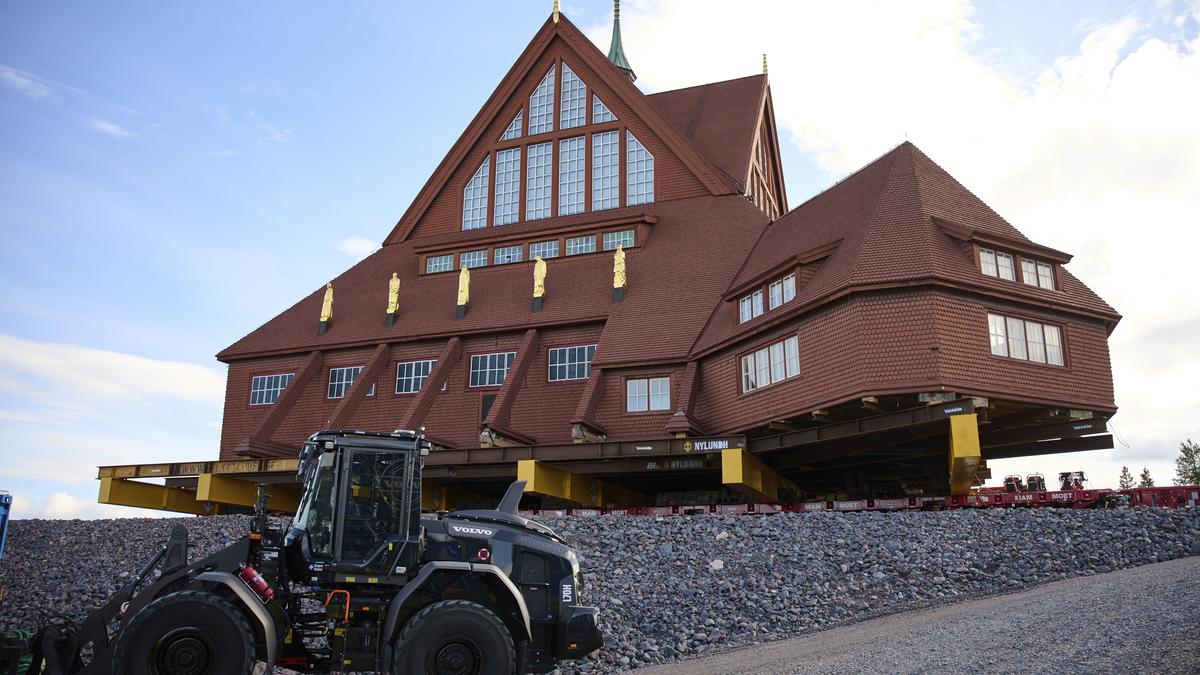
Historic Swedish church arrives at new home after two-day journey
August 20, 2025e-Paper
The View From India Looking at World Affairs from the Indian perspective.
First Day First Show News and reviews from the world of cinema and streaming.
Today's Cache Your download of the top 5 technology stories of the day.
Science For All The weekly newsletter from science writers takes the jargon out of science and puts the fun in!
Data Point Decoding the headlines with facts, figures, and numbers
Health Matters Ramya Kannan writes to you on getting to good health, and staying there
The Hindu On Books Books of the week, reviews, excerpts, new titles and features.
August 20, 2025e-Paper
Historic Swedish church arrives at new home after two-day journey
A musical fanfare celebrated its arrival after a meticulously choreographed relocation that began on Tuesday on two remote-controlled flatbed trailers inching forward at a pace of half a kilometre an hour
Published - August 21, 2025 12:08 am IST - Kiruna, Sweden
Construction machinery is parked next to the Kiruna Church, a Sami style wooden Swedish Lutheran church, called Kiruna Kyrka in Swedish, in Kiruna, Sweden, Wednesday, Aug. 20, 2025, after the completion of its move along a 5-km. (3-mile) route east to a new city centre as part of the town’s relocation. | Photo Credit: AP
A landmark Swedish church arrived on Wednesday (August 20, 2025) at its new home after a two-day move across the Arctic town of Kiruna, in a move to allow Europe's largest underground mine to expand.
The red wooden Kiruna Kyrka, which dates from 1912 and weighs 672 tonnes, completed its five-kilometre (three-miles) journey around 2:30 p.m. (1230 GMT).
A musical fanfare celebrated its arrival after a meticulously choreographed relocation that began on Tuesday on two remote-controlled flatbed trailers inching forward at a pace of half a kilometre an hour.
Kiruna's entire town centre is being relocated because of the giant LKAB iron ore mine, whose ever deeper burrowing over the years has weakened the ground.
A stone's throw from where the structure was inching into place next to the town's cemetery, Lutheran vicar Lena Tjarnberg held a church service for dignitaries in a tent resembling a "laavu", the traditional tent of the region's Indigenous Sami people.
"Our beloved, beloved church began its journey yesterday from its unbelievably beloved location. Now it is on its way home," she said.
The journey went smoothly for the 1,200-tonne convoy, despite some tricky narrow passages and 90 degree turns, officials said.
The relocation has generated widespread interest, with large crowds thronging the streets of the town of 18,000 people.
A construction worker sits next to the Kiruna Church, a Sami style wooden Swedish Lutheran church, called Kiruna Kyrka in Swedish, in Kiruna, Sweden, Wednesday, Aug. 20, 2025, after the completion of its move along a 5-km. (3-mile) route east to a new city centre as part of the town’s relocation. | Photo Credit: AP
Lisa Weber, a 26-year-old real estate agent, had travelled from her home in Germany to Kiruna to be able to witness what she called a "historical" event.
"It's something that you do once in your life, or see once in your life, and it's such a long distance from the old place to the new place," Ms. Weber told AFP, adding it was "very interesting" to see the elaborate process.
LKAB said the new location had been "chosen with great care to preserve its character and connection to the surroundings."
"The building has been rotated 180 degrees, meaning that the altar now faces west — a symbolic choice that opens the church towards the city and its residents," the state-owned company said in a statement.
LKAB added it was attempting to create a "cohesive whole" with other cultural buildings set to be moved.
King Carl XVI Gustaf took part in Wednesday's festivities, exchanging a few words with driver Sebastian Druker, an Argentinian, who controlled the trailers remotely with a joystick.
The 79-year-old king was also expected to take part in an attempt to break the world record for the number of people attending a "kyrkkaffe", a coffee break in conjunction with a church service.
The town's relocation process began almost two decades ago and is expected to continue for years to come. The new town centre was inaugurated in September 2022.
People gather outside the Kiruna Church, a Sami style wooden Swedish Lutheran church, called Kiruna Kyrka in Swedish, in Kiruna, Sweden, Tuesday, Aug. 19, 2025, during its move along a 5-kilometre (3-mile) route east to a new city centre as part of the town’s relocation. | Photo Credit: AP
The company offered to financially compensate those affected by the town's relocation, or rebuild their homes or buildings. A total of 23 historic buildings have already been moved before the church, according to LKAB.
Yet many Kiruna residents are unhappy.
Alex Johansson and Magnus Fredriksson, who host a podcast on local Kiruna news, were critical of the mining company.
"LKAB maybe didn't read the room so well when they destroyed the whole town and then they stage this huge street party for the people," Mr. Fredriksson told broadcaster SVT, watching as the church rolled slowly down the road.
"It's like they said 'Here's some storage space for you, Kiruna. Now we're going to continue raking in the billions from here'," Mr. Johansson added.
They were happy the church had at least been saved, and hadn't ended up "as woodchips like the rest of Kiruna".
LKAB, which is extracting iron ore at a depth of 1,365 metres, announced in 2023 that it had discovered Europe's largest known deposit of rare earth elements right next to the Kiruna mine.
Rare earths are essential for the green transition, used in the manufacturing of electric vehicles.
LKAB chief executive Jan Mostrom told AFP the deposit was "very important for Europe", as the continent seeks to reduce its dependence on imports from China.
Activists argue the mining operations destroy the area's pristine forests and lakes and disturb traditional Sami reindeer herding in the area.
The relocation of the church alone was expected to cost LKAB some 500 million kronor ($52 million).
Designed by Swedish architect Gustaf Wickman, the church, which measures 40 metres (131 feet) tall, is a mix of influences and includes designs inspired by the region's Indigenous Sami people on the pews.
The neo-Gothic exterior features slanting roofs and windows on each side, while its dark interior has elements of national romanticism as well as an Art Nouveau altarpiece and an organ with more than 2,000 pipes.
The church's handblown glass windows were removed ahead of the move, replaced with painted plywood.
The belltower, which stood separately next to the church, will be moved next week.
Published - August 21, 2025 12:08 am IST
Related Topics
Terms & conditions | Institutional Subscriber
Comments
Comments have to be in English, and in full sentences. They cannot be abusive or personal. Please abide by our community guidelines for posting your comments.
We have migrated to a new commenting platform. If you are already a registered user of The Hindu and logged in, you may continue to engage with our articles. If you do not have an account please register and login to post comments. Users can access their older comments by logging into their accounts on Vuukle.
Post a Comment