100 elephants and their designer blankets on The Great Elephant Migration
July 25, 2025e-Paper
The View From India Looking at World Affairs from the Indian perspective.
First Day First Show News and reviews from the world of cinema and streaming.
Today's Cache Your download of the top 5 technology stories of the day.
Science For All The weekly newsletter from science writers takes the jargon out of science and puts the fun in!
Data Point Decoding the headlines with facts, figures, and numbers
Health Matters Ramya Kannan writes to you on getting to good health, and staying there
The Hindu On Books Books of the week, reviews, excerpts, new titles and features.
July 25, 2025e-Paper
100 elephants and their designer blankets on The Great Elephant MigrationPremium
Featuring 55 designers from across the globe, The Great Elephant Migration embodies artistry, sustainability and the need for human-wildlife coexistence
Published - July 25, 2025 12:35 pm IST
The Great Elephant Migration | Photo Credit: Ronnie Dai
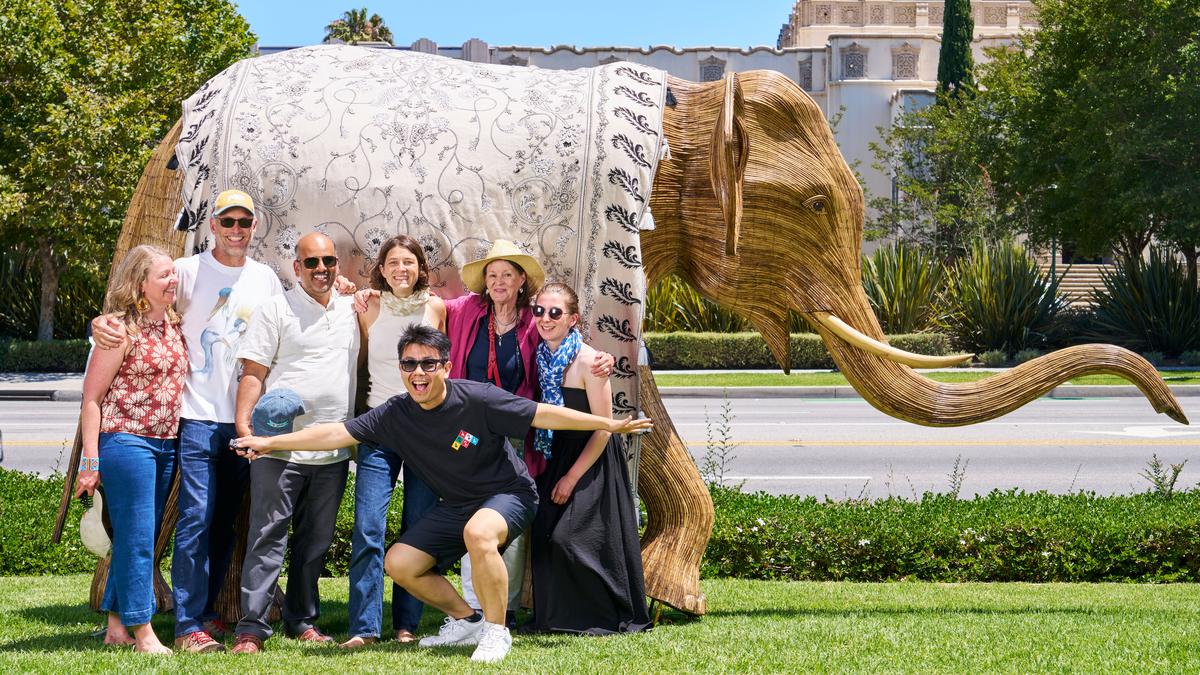
Last Sunday, 100 elephants entered Beverly Hills’ palm-lined streets, home to many Hollywood stars. No one backed away in fear, though — because the large beasts were handcrafted from the invasive Lantana camara plant, and travelled on trucks decorated with vibrant Indian lorry art.
It was the last leg of The Great Elephant Migration, a 5,000-mile installation art journey across the United States, through cities, national parks, and tribal lands, supported by over 20 conservation organisations. The life-size pachyderms were draped in ceremonial blankets created by 55 renowned designers and indigenous communities from around the world.
Elephant sculptures in Beverly Hills | Photo Credit: AFP
The story began decades ago when Mark Shand, author, conservationist, and brother to Britain’s Queen Camilla, experienced the emotional bond between elephants and people in India. He adopted an Asian elephant named Tara in 1988, traversed 600 miles with her across the country, and later founded the non-profit Elephant Family in 2002, which he led until his death in 2016. His legacy continues today through cultural conservationist Ruth Ganesh, principal trustee of the Family, and the work of The Real Elephant Collective, based in Tamil Nadu. The two collectives often collaborate on projects, such as the Migration, to raise funds to restore coexistence between people and elephants.
The Great Elephant Migration travelling public art show | Photo Credit: Ronnie Dai
The Collective is a sustainable, community-owned enterprise that employs 200 indigenous artisans from the Nilgiri Biosphere Reserve. Over five years, the craftspeople have replicated 160 elephants — all identified and named — making each piece a sculptural echo of a living animal.
In the past two years, the herd has appeared at Rewild, designer Anita Dongre’s showcase at the City Palace in support of the Nature Conservation Foundation, and at designer Sabyasachi Mukherjee’s 25th anniversary exhibition at NMACC this January.
In the U.S., the elephants have journeyed from Newport through New York, Miami Beach and the Blackfeet Nation in Montana, to Los Angeles. The artisans joined the convoy in the final 1,000-mile leg. And the culmination is Wrapped in History, the series of ceremonial blankets curated by product designer Vikram Goyal, being auctioned on Artsy (till August 1).
Bulls, cows, and calves were shaped with anatomical precision | Photo Credit: Ronnie Dai
The idea for the bespoke blankets was born at All Night Smoke, an event hosted by their partner INDIgenous Led. “What struck me was the powerful presence of blankets,” reminisces Ganesh. “Members of the community explained that they are symbolic — given to mark the end of something meaningful, or as a gesture of honour.”
The sentiment is echoed by Elephant Family’s first-ever curator, Goyal. “Blankets hold cultural weight across indigenous communities globally,” he says. “They signify protection, memory, belonging.” Ganesh had worked with Goyal during the Elephant Parade in Mumbai in 2018, and roped him in to curate the series. “He has a rare ability to bridge Indian craftsmanship with global aesthetics.”
Vikram Goyal and Ruth Ganesh
Goyal, whose Vikram Goyal Studio collaborates with master artisans, epecially in metalwork, brings a designer’s touch to the project. His blanket draws on A Book of Dreams, his own repoussé artwork — inspired by an eponymous manuscript featuring mythical animals such as the gajasimha (half-lion, half-elephant) and black geese, which are symbols of fertility, prosperity and protection.
The blankets feature marquee creators, including Sabyasachi, Elie Saab, Ralph Lauren, Diane von Furstenberg, Tarun Tahiliani, Raw Mango, Ozwald Boateng, and younger labels such as Lovebirds and Dhruv Kapoor. Indigenous representation comes from communities, including the Navajo Nation, Maasai, Snoqualmie, and India’s Soliga and Betta Kurumba tribes.
“At Chanakya, we believe that the act of making is also an act of listening — to nature, to memory, and to one another. Equilibrium is our offering for The Great Elephant Migration, a ceremonial blanket created in honour of the matriarch, the wise and guiding force of the herd. Crafted from pine needle waste, banana fibre, mulberry bark, flax, and hemp, each thread is drawn from forest remnants and transformed through over 45 days of handwork by the master artisans at the Chanakya ateliers. The piece pays tribute to the elephant as a quiet architect of the forest and a symbol of coexistence. It reflects our belief in more reciprocal, respectful ways of living.”Karishma SwaliFounder and chairperson, Chanakya School of Craft
Blanket by Chanakya School of Craft | Photo Credit: Ronnie Dai
Zardozi, himroo, ajrakh, patchwork — numerous Indian crafts find their rightful place amidst the weaves. Among the standout pieces is a design from Heirloom Naga, a creative platform that supports loin-loom weaving. Founder-designer Jesmina Zeliang, who lives near the elephant corridors in India’s Northeast, was inspired by thupikhu, or elephant cloth, of the Chakhesang tribe in Nagaland — a garment worn by men who had hosted feasts of merit. Woven on loin looms, it is vivid and symbolically rich. “The elephant motifs signify not only the wearer’s strength but also his community stature,” Zeliang tells me.
Blanket by Heirloom Naga | Photo Credit: Ronnie Dai
Textile designer Ashdeen Lilaowala’s contribution bridges continents. His piece draws from Spanish flamenco shawls, beloved in old Parsi homes where they are often used to cover grand pianos. His blanket blends embroidered birds and floral patterns from the Parsi gara vocabulary with flamenco-style tassels.
Blanket by Ashdeen Lilaowala | Photo Credit: Ronnie Dai
Meanwhile, Weavers Studio Resource Centre, an active textile archive led by Darshan Shah, was inspired by an old Oxfam calendar featuring nakshi kantha, a type of embroidered quilt, as well as appliqué, batik, and cotton gamcha lining. “The centre [of the blanket] is a dreamlike world — elephants, tigers, paisleys, and vines bursting across handwoven tussar silk. But the true magic lies in the margins. You’ll see women, mid-stitch, caught in the act of creation. It’s a kantha about women making a kantha.”
Blanket by Weavers Studio Resource Centre | Photo Credit: Ronnie Dai
Blanket by Masaba Gupta | Photo Credit: Ronnie Dai
Blanket by Ritu Kumar | Photo Credit: Ronnie Dai
What began as a herd of lantana elephants now carries a heavier load — stitched stories of land, memory, and shared futures. The migration may end here, but the message continues. “Once that elephant tusk tugs at you strong,” says Ganesh, “it doesn’t let go.”
The writer is a Mumbai-based fashion stylist.
Published - July 25, 2025 12:35 pm IST
Related Topics
Top News Today
Terms & conditions | Institutional Subscriber
Comments
Comments have to be in English, and in full sentences. They cannot be abusive or personal. Please abide by our community guidelines for posting your comments.
We have migrated to a new commenting platform. If you are already a registered user of The Hindu and logged in, you may continue to engage with our articles. If you do not have an account please register and login to post comments. Users can access their older comments by logging into their accounts on Vuukle.
Post a Comment